The Price of Beauty: Brass Coils and the Kayan Lahwi Tribe
- katedeville21

- Apr 28, 2024
- 4 min read
Updated: May 25, 2024

"Beauty is in the eye of the beholder".
"Beauty is pain".
We've all heard these sayings, and they bring to mind how beauty is arbitrary and how one must slightly suffer to be beautiful. In the West, a woman might undergo plastic surgery to obtain a particular aesthetic, defy spatial reasoning by squeezing herself into a dress two sizes too small, or strut around in high-heels that constrain the natural movement of her feet.
To the Kayan Lahwi, also known as the Padaung or the Longneck Karen Tribe, a female's beauty is achieved with "wang". Wang is not only a symbol of beauty, but it's a mark of identity. Wang is brass coil wrapped around a female's neck and lower limbs. The process starts young at the age of five, and as the child matures, more loops of the coil are added around the neck. Typically, there are around 16-22 loops, and the coil can weigh from 3-20 kilos (around 6.6-48.5 pounds). The weight of the metal pushes the shoulders and collarbone down-collapsing the ribcage, giving an illusion of an elongated neck. The process comes at a cost of being painful, but it also has other serious side effects such as scarring and muscle loss.

While severe and torturous to the modern eye, the tradition is rooted in the Kayan people's origin story. Legend tells of a female dragon ancestor that morphed into a human woman, having two offspring with a human male. Their offspring created the existence of the Kayan people, and the women wear the brass coils in reverence to their dragon ancestor. Other suggested reasons for the coils are to prevent other tribes from desiring the Kayan Lahwi women, protect against tiger bites, and accentuate sexual dimorphism within the tribe.
Originally from Myanmar, which is in the middle of a 4 year civil war, the Kayan are being persecuted by the government for their traditional ways-which seem primitive to the developed countries. Many have fled to Northern Thailand to seek refuge, but instead of gaining political and social freedom, many Kayan find themselves a part of a tourist scheme. The Thai government has designated villages which allow for a traditional lifestyle, but to support the community, the government charges tourists around 500 baht to catch a glimpse into tribal life. This entrance fee goes towards a meager living stipend which can vary. The handicrafts sold within the villages go directly to the vendors-which is their primary source of income.
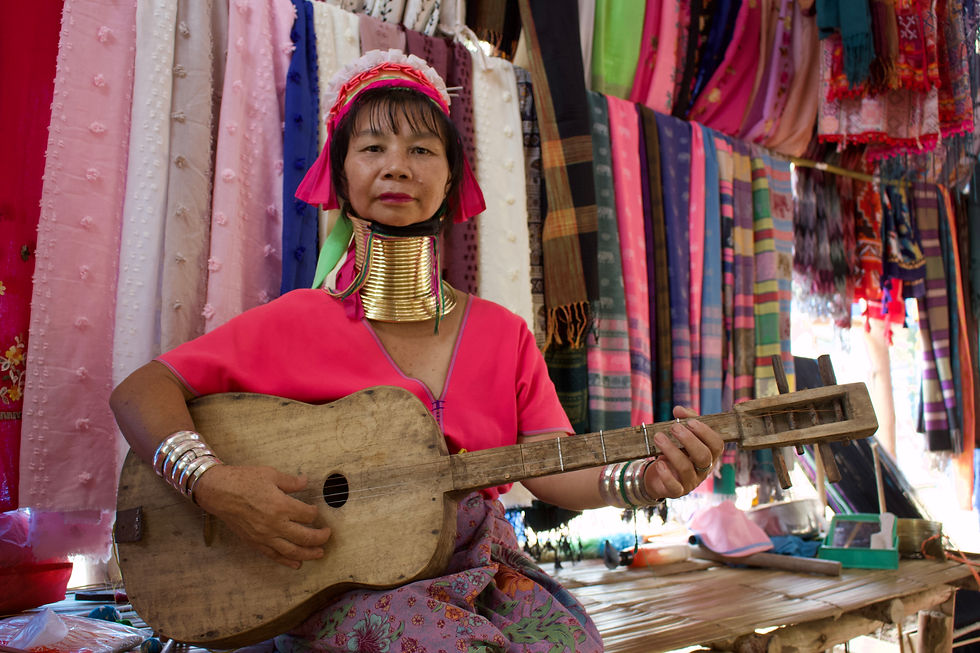
The system is a double-edged sword. On one hand, the Kayan are able to preserve their culture, escape political turmoil, and sustain themselves within the tourist village; however, on the other hand, they have limited rights and opportunities, and they are unable to obtain Thai citizenship. Some argue the villages commodify culture and pressure younger generations to partake in tradition in order to drive tourism.
As I walked through a Kayan Lahwi village which was about a 35 minute drive from Chiang Mai, Thailand, I felt shy greeting a local woman-her neck in coils and her hair decorated in traditional garb. To gaze too long felt intrusive, so I greeted her with "sawadeeka" ("hello" in Thai) and a smile, and I kept walking past the various handicraft stalls. I was the first visitor of the day, and I was greeted by more local women and young girls who promptly drew attention to their scarfs and trinkets. I was eager to take photos right away, but my moral compass said otherwise.
I've been backpacking for two months now, and one of the most valuable lessons I've learned as a travel, portrait photographer is to interact with your subject before snapping a shot. In most cases, to do otherwise is an act of desperation-and perhaps of exploitation. I promised myself that I wouldn't ask for a photo unless I bought something.
Each stand sold nearly identical items-brass necklaces, bracelets, rings, and cotton scarves. Some younger girls, their faces painted with pale yellow circles and other markings and their necks wrapped in coils, drew attention by operating a loom-but their demonstration felt aimed more for show rather than productivity. The older women were obviously more skilled, intricately weaving a multitude of colors to achieve a particular design.
Witnessing and interacting with the girls, mainly around 8-10 years of age, disturbed me. As a westerner, it's sometimes hard to accept different cultural practices when it involves children. I grew anxious thinking about their futures-how the coils would impact their bodies and what opportunities they'd receive in life. Many of the young women were already mothers, straddling infants, and I wondered if that was each girls' eventual fate-even if they desired another.
I ended up buying two scarves, one poncho, one bracelet, a necklace, and a bookmark-trying to chat with each person I interacted with as much as our language barrier would allow. I asked one woman about the coils just below her knees. She was sitting on a wooden platform outside the hut, working on a loom-her legs stretched out. She lifted the coil to reveal discoloration and scarring, and she explained that it was painful.


As I took the photos, I noticed suffering in some of the women and girls' eyes-a deep struggle. The younger kids, around 6, were giggly and happy, but the older girls seemed to bear a greater burden of responsibility.
The moral dilemma with this visit was strong. While some people believe these villages are "human zoos", selling handicrafts is one of the only reliable sources of income for the Kayan at this moment; tourism does support a somewhat decent way of life. It's important for each tourist to be aware they're invading people's personal space by entering a village (they live in huts behind the stalls), learn about their history and current struggles, and give back by purchasing items.
As I was leaving the village, a little overwhelmed with cultural differences and the pressure to buy from each stall, I came across a bunch of six year olds. I broke my promise and I asked for a photo of the kids. Both the guardians and the kids agreed, and the little ones eagerly posed with peace signs and thumbs up on a bench.

I showed them the end-results, we high-fived, and I returned back to Chiang Mai-a little more humbled than before I left.


Comments